It will be hard to ignore: This is an election year. So our very political health secretary, RFK Jr., is making a pivot. It turns out that making polio and measles great again is not resonating well with voters. Much of the public hates his vaccine policies. On the other hand, yelling at people to “Eat Real Food” probably sounds OK to a larger (and more diverse) audience.
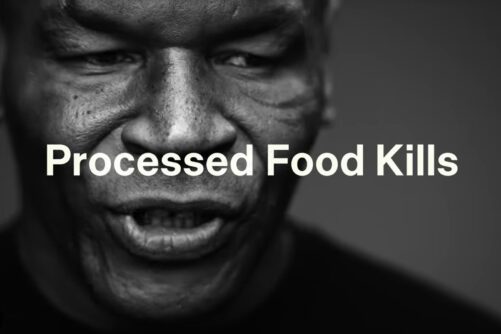
So are we shocked that the MAHA Center would spend something like $8 to $10 million on an ad during the Super Bowl with Mike Tyson scolding everyone about what they eat? Not a bit.
But it likely will do nothing to make America healthier.
Shame and Self-Loathing
The ad came with ample doses of shame and self-loathing:
“I was so fat and nasty I would eat anything. I was like 345 pounds. A quart of ice cream every hour. I had so much self-hate when I was like that, I just wanted to kill myself.”
He goes on to say that Americans are “the most obese, fudgy people” in the world. His feelings about this are plain. But amplifying that disgust is not helpful.
He chomps on a carrot and an apple, to make it clear that the answer to obesity is really quite simple.
Good Nutrition Matters
A new study in the American Journal of Clinical Nutrition reminds us that the quality of nutrition really does matter. Jeffrey Brunstrom and colleagues re-analyzed data from the landmark study of ultra-processed and minimally-processed foods by Kevin Hall. They found that unprocessed meals reduce energy intake for two reasons.
First, they have a less balanced blend of calories from fat and carbs. The researchers suppose that processed foods, delivering plenty of calories from both fat and carbs, are more rewarding than unprocessed foods delivering calories mainly from one or the other.
Second, unprocessed foods deliver more micronutrients with fewer calories. The researchers in this study invoke a theory called micronutrient deleveraging. In this way of thinking, people innately seek enough food to satisfy their needs for various micronutrients. When people get those micronutrients from an unprocessed diet, they naturally eat less.
These theories, of course, are just that – theories. The data from this study aligns with the theories, but further research would be necessary to make firm conclusions.
Scolding Doesn’t Work
Whatever the merits of those theories, one thing is clear. Scolding is not an effective way to have people change their dietary patterns. It only promotes stigma. Mike Hale, a TV critic for the New York Times, sums it up quite well:
“Mike Tyson delivers a pitch for ‘real food’ in the same pummeling, unsubtle style he used in his prime as a boxer. Arresting but amorphous. And is hectoring people the best strategy for getting them to change their eating habits?”
He ranked this ad in the bottom third of all ads aired during the Super Bowl.
Click here for the new study in AJCN, here for more on RFK Jr.’s pivot to real food messaging, here and here for more on the Super Bowl advertising. For a fresh and compelling point of view, click here.
Mike Tyson: Eat Real Food, advertising by the MAHA Center Inc.
Subscribe by email to follow the accumulating evidence and observations that shape our view of health, obesity, and policy.