
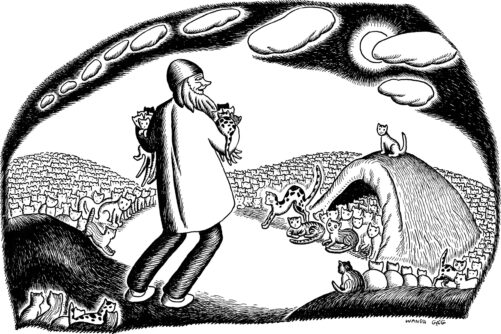
Everyone seems to know it. We need something better than BMI to serve as a clinical index for the diagnosis of obesity. But getting them to move on is like herding millions of cats. Agreement on the substitute and movement toward it is hard to find.
In Search of an Alternative
Writing on Medscape, obesity medicine physician Caroline Apovian notes a broad agreement that BMI alone is inadequate. The Lancet Commission made that clear. But she notes that the details of the commission’s recommendations for better precision might be “onerous” in practice. One of those recommendations was to use waist circumference in addition to BMI. In fact, almost 30 years ago, the first obesity treatment guidelines recommended this. At the time, supporting evidence for this recommendation was “limited.”
Could Relative Fat Mass Be Better?
Apovian suggests that a better index is available to us: relative fat mass or RFM. She explains:
“This simple calculation incorporates waist circumference as a proxy of visceral body fat while accounting for sex-based differences in fat mass. Multiple studies have shown RFM to be a superior and more consistent predictor of cardiometabolic risk and mortality.
“RFM has also outperformed BMI in estimating body fat percentage in children and adolescents, measured using DEXA. For children and adolescents aged 8-14 years, a modified RFM for pediatric populations was successfully tested against BMI for age percentiles.”
Herding Cats
There’s just one little problem. While primary care providers routinely collect height and weight, they seldom measure waist circumference. In fact, it is fair to say they reject it.
Can a superior index for obesity risk be enough to motivate all of primary care to start collecting waist circumference? We have some doubts. These cats resist herding.
Other alternatives are in play. Bioimpedance analyzers have some popularity in obesity medicine practices. But it is hard to imagine they will migrate broadly into primary care. Especially when some experts have issues with their limitations.
Another option is digital anthropometry. Something as simple as a smartphone app can give a reasonably accurate assessment of body composition from a few digital pictures of a person. But more work will be necessary to standardize this methodology and win broad acceptance.
Herding cats is not easy.
Click here for Aprovian’s essay on Medscape and here for an assessment of options for moving forward.
Cats All Around, Illustration for Millions of Cats by Wanda Gág / Wikimedia Commons
Subscribe by email to follow the accumulating evidence and observations that shape our view of health, obesity, and policy.

December 31, 2025 at 3:58 am, John Dixon said:
BMI is not only an excellent metric for fat mass, but also strong for lean body mass.
Intentional weight loss is expected to reduce lean body mass along with fat mass in a predictable ratio.
It’s excessive loss of lean body mass (muscle mass) that is the issue.