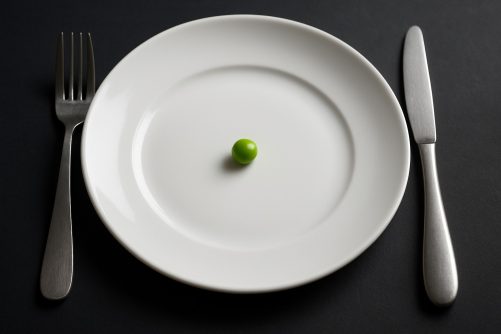
Professor Naveed Sattar has a modest proposal for us. He chairs the UK government’s obesity healthcare goals and says smaller portions might hold the key to reducing obesity in women, children, and shorter persons. Sattar writes in Lancet Diabetes & Endocrinology:
“When only one portion size is offered, women, children and individuals of shorter stature are therefore routinely served more calories than needed, contributing to gradual but progressively greater average adiposity gain than in men. This effect is amplified in lower socioeconomic status groups, where access to affordable, appropriately sized meals is more scarce.
“We propose that food outlets offer at least two portion sizes for common single portion ready-to-eat products, differing by around 25% – the average difference in energy requirements between men and women – and priced fairly.”
This simple strategy has many other benefits according to Sattar. It will, he says, reduce food waste and mitigate obesity disparities. Restaurants and food companies could gain competitive advantage, he supposes, by selling less food and charging less for it.
Why hasn’t anyone thought of this elegant solution before?
Been There, Done That
It turns out that people have thought of this before. About 20 years ago. Ruby Tuesday is a fast casual restaurant chain that decided to distinguish itself by selling healthier, smaller portions. People hated it so much that they dropped the idea within a few months. A few years later, the chain declared bankruptcy.
In an interview for the BBC, Sattar said, “Food companies and drinks companies are making huge amounts of profit. Perhaps they need to make slightly less profit to make healthier versions.”
He went on to describe his wife over-consuming a large portion of breakfast cereal because of serving size. We wonder how she felt about being the evidence base for his policy ideas.
In any event, we have some difficulty imagining this concept will prove to be popular.
Bidirectional Causality
More problematic is the presumption that portion sizes are the cause and not an effect of increased obesity prevalence. It is entirely plausible that food companies are simply offering portion sizes that satisfy their customers. In this way of thinking, market demand for larger portions goes up as obesity becomes more common and appetites begin favoring those larger portions. Which comes first? We suspect the causality is bidirectional at the very least.
Certainly, we are now seeing that restaurants are having to offer smaller portions as more people are taking highly effective obesity medicines. A significant part of their customer base is now repelled by excessive portions. So in this way, providing effective obesity care might serve to change our food environment for the better.
Thus we have our doubts that this is a winning proposition – either for moving the needle on obesity or for the businesses that would have to adopt it. It only works for people who dismiss the biological basis of obesity and conceive of it as a problem of bad behavior.
Click here for Sattar’s perspective in Lancet Diabetes & Endocrinology, here for an interview with the Daily Mail, and here for his BBC interview (it comes at 12 minutes and 37 second into this podcast).
Portion Control, illustration created for ConscienHealth with OpenAI 4o image generation
Subscribe by email to follow the accumulating evidence and observations that shape our view of health, obesity, and policy.