

Empathetic, respectful care sounds like a reasonable expectation for a primary care visit. New research, conducted by the Obesity Action Coalition, Drexel University, the ABOM Foundation, and Thoughtform, shows the way to take this from an aspiration to reality. Simply stated, persons living with obesity want more respect and less finger pointing in primary obesity care.
This new publication in Patient Education and Counseling suggests that appropriate facilities, listening, referrals, and less preoccupation with weight could take us there.
A Co-Design Process
These findings emerged from a co-design process that engaged people living with obesity as equal partners in developing an ideal primary care approach to obesity. Workshops engaged patients, advocates, process designers, and academics to explore human needs and then design and validate a better approach.
Appropriate Facilities
Simply put, many settings for primary care do not accommodate larger people. Small gowns may serve to humiliate. Exam tables, furniture, and diagnostic equipment may not work for a larger body. The implicit message is clear: You don’t belong here. People get it and stay away.
The recommendation from this research is clear. “Adequate equipment for all bodies creates an inclusive environment.”
Listening
For anyone who has read the research on weight bias in healthcare, the need for better listening should not be a surprise. This arose in a key theme from interviews with patients. “The doctor doesn’t listen to me. Only lectures me, like somehow I don’t know I’m fat.”
Without empathetic listening skills, primary care for obesity is not possible.
Referrals
Obesity is a complex, chronic disease. The condition and medical needs can range from straightforward to maddeningly challenging. A primary care provider with a good understanding of obesity can deliver competent care for many patients. Even so, patients who present more complexity and greater needs require appropriate referrals for adequate care. The needs can be quite diverse for achieving optimal health.
Preoccupation with Weight
We live in a culture preoccupied with body image and weight. It does not help for healthcare to reinforce this. Not every patient needs weighing on every visit. Some patients have strong feelings about when and how it’s done. Some clinics do it in very public and embarrassing ways.
A preoccupation with weight can serve to stigmatize larger people and distract attention from the primary goal – achieving the best possible health for a person.
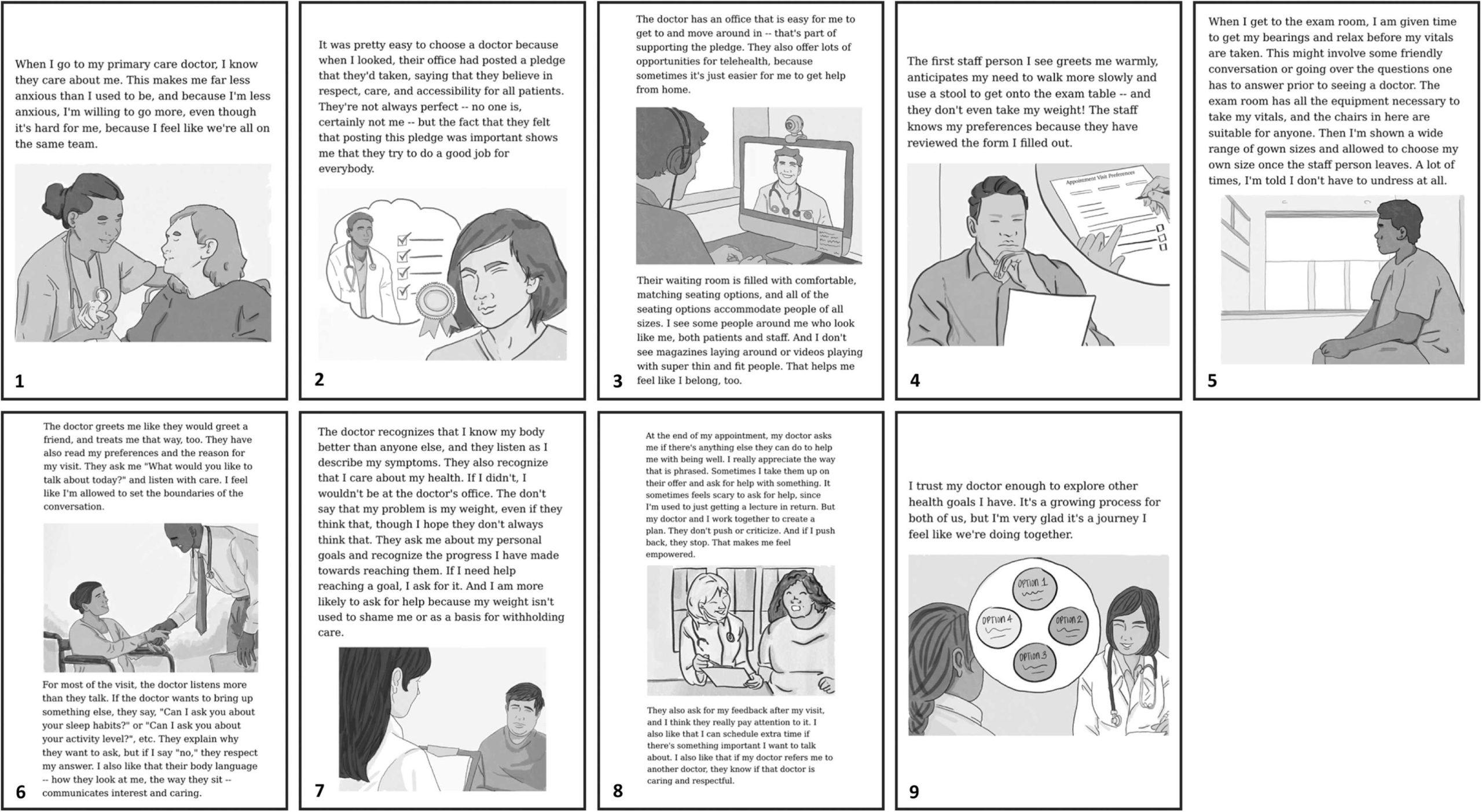
Primary Care Reimagined. CC BY-NC-ND 4.0 from doi:10.1016/j.pec.2025.109190
Reimagining Primary Care for Obesity
We are quite proud of this work, authored by Kristal Brown, Gwyn Cready, Katie Schmiedicker, Michelle Vicari, James Zervios, Kimberly Gudzune, and ConscienHealth’s own Ted Kyle. It paints a vivid picture of how good primary care can be at caring for persons with obesity.
Even more pride comes from seeing signs that things are moving in that direction.
Click here for free access to the publication, here and here for further reporting on it.
Pointing the Finger, illustration created with Gemini image generation
Subscribe by email to follow the accumulating evidence and observations that shape our view of health, obesity, and policy.

August 31, 2025 at 9:19 am, Skip Murray said:
This one gets a heartfelt “YES, PLEASE” from me.
I struggle with self-esteem and self-confidence.
I hate going to the clinic; it just erodes the little self-esteem I have. Here are some of the reasons why:
Waiting room with chairs not made for large bodies. The arms of the chairs have bruised my hips.
My name gets called, and the nurse calling it stops smiling as soon as I stand up. Right inside the waiting room door, in the hallway leading to all the exam rooms, is a scale. The nurse says my weight loudly. Did the people in the waiting room or any of the exam rooms hear the nurse?
Let’s not forget all the times I hear a sigh, because they are tired of saying it and nothing changes – the doctors and nurses who will tell me, “You need to lose weight.” Some will mention “diet and exercise.” Once, one offered to refer me to a nutritionist. It is obvious to me that they feel my size is my fault, and they are frustrated that I don’t do something about it.
I can still feel the pain of the blood pressure cuff that was too small and bruised my arm. There was a larger one in the exam room, but it malfunctioned. The nurse did not try to locate a larger one that worked.
Too many times, I’ve been given a gown that is too small for me. I am very bashful. It is already a struggle to have to disrobe and let people see my body. Do I also have to endure the shame of not even being able to close the gown? To have gown arms so small that they are digging into me and causing pain? Or the time the gown was so small that I couldn’t put my arms in it and had to drape it over me like a sheet (it felt the size of a baby blanket to me).
Prove to me that exercise is good for your health, and the next time something doesn’t fit my large body, walk down the hall and grab the right size of blood pressure cuff, gown, or other necessary item, making me feel cared for, instead of me sitting in a cold room suffering a flood of shame.
Better yet, would be exam rooms equipped adequately for people of all sizes, so that no special attention (read staff inconvenience) needs to be taken at all. Remove the potential for shame.